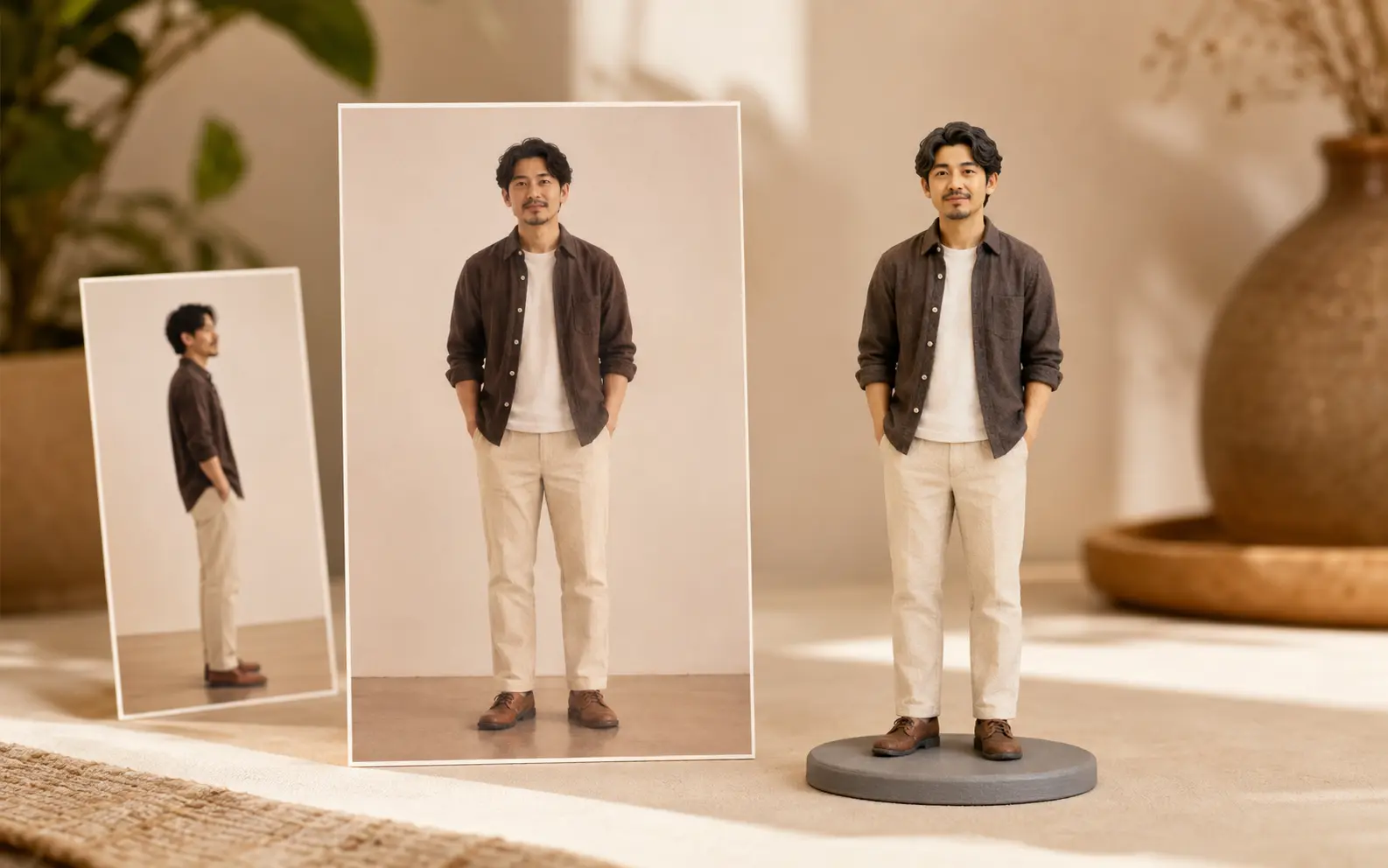
The photo you love and the photo that works as a reference are often not the same picture. A reference has one job: to carry enough information about a person that the same person can be rebuilt as a physical object, from every angle, including the angles the camera never saw. That is a different standard from a good photograph, and it is worth understanding before you choose.
What “sharp enough” actually means
Resolution matters far less than where the resolution is spent. A 12-megapixel photo where the face occupies a two-hundred-pixel square carries less usable information than a smaller image where the face fills a third of the frame. Before anything else, crop to the face on your phone and see whether it survives the zoom.
The practical threshold is simple: if you cannot make out the shape of the hairline and the outline of the eyes when you zoom in, neither can we. Nothing later in the process recovers detail that was never captured — sharpening an image invents texture, it does not restore information.
The four ways light goes wrong
Backlight is the most common. Standing with a window or the sun behind you turns the face into a silhouette, and a silhouette has no colour information for skin, eyes or hair. Turn around so the light falls on you rather than behind you.
Hard overhead sun is the second. Midday light drops the eyes into shadow and cuts a hard line under the nose and chin. Open shade — under a tree, in a doorway, on the shadowed side of a building — gives a far more usable face than direct sun.
Mixed light is the subtle one. A room lit by a warm bulb and a cold window at once gives the face two different colours across it, and neither is the colour you actually are. Direct flash is the fourth: it flattens the face and removes the shading that tells us how it is shaped.
Why portrait mode is a trap
Phone portrait modes blur the background to imitate a wide aperture, and the boundary they draw between subject and background is an estimate. It usually fails in exactly the place that matters most for a figurine: the outer edge of the hair.
Loose strands, curls and anything wispy get read as background and softened away. The result is a photograph with a clean, pleasant silhouette that is not your silhouette. If you have the same shot with the effect off, send that one.
Clothing, pose and the things people recognize
Recognition at a small scale is carried by the outline more than the face. That makes clothing unusually important: a distinctive jacket, a collar shape, a colour combination someone always wears, will do more work than a perfectly lit portrait in a plain t-shirt.
The same is true of stance. People are recognized by how they stand long before anyone is close enough to see a face, so a photo that captures a characteristic posture is worth more than a formal one that does not.
- The face large enough to zoom into without it falling apart
- The whole hairstyle, including its outline
- The clothing you actually want on the figurine
- A pose that looks like the person, not like a passport photo
Old, scanned and imperfect photos
Old photographs work more often than people expect, because what they lose is usually not what we need. Grain, faded colour and slight softness are survivable. What is not survivable is a face that was small in the original frame, because scanning cannot add detail that the negative never held.
Scan rather than photograph a print where you can, and scan the whole print rather than cropping. Colour shifts in old prints are predictable and correctable; a phone photo of a print taken at an angle, with a reflection across the face, is not.
When the only good photo is a bad photo
Sometimes the picture that matters is the only one that exists, and it is blurry, or distant, or taken twenty years ago. That is a normal starting point rather than a disqualifying one — memorial commissions almost always begin there.
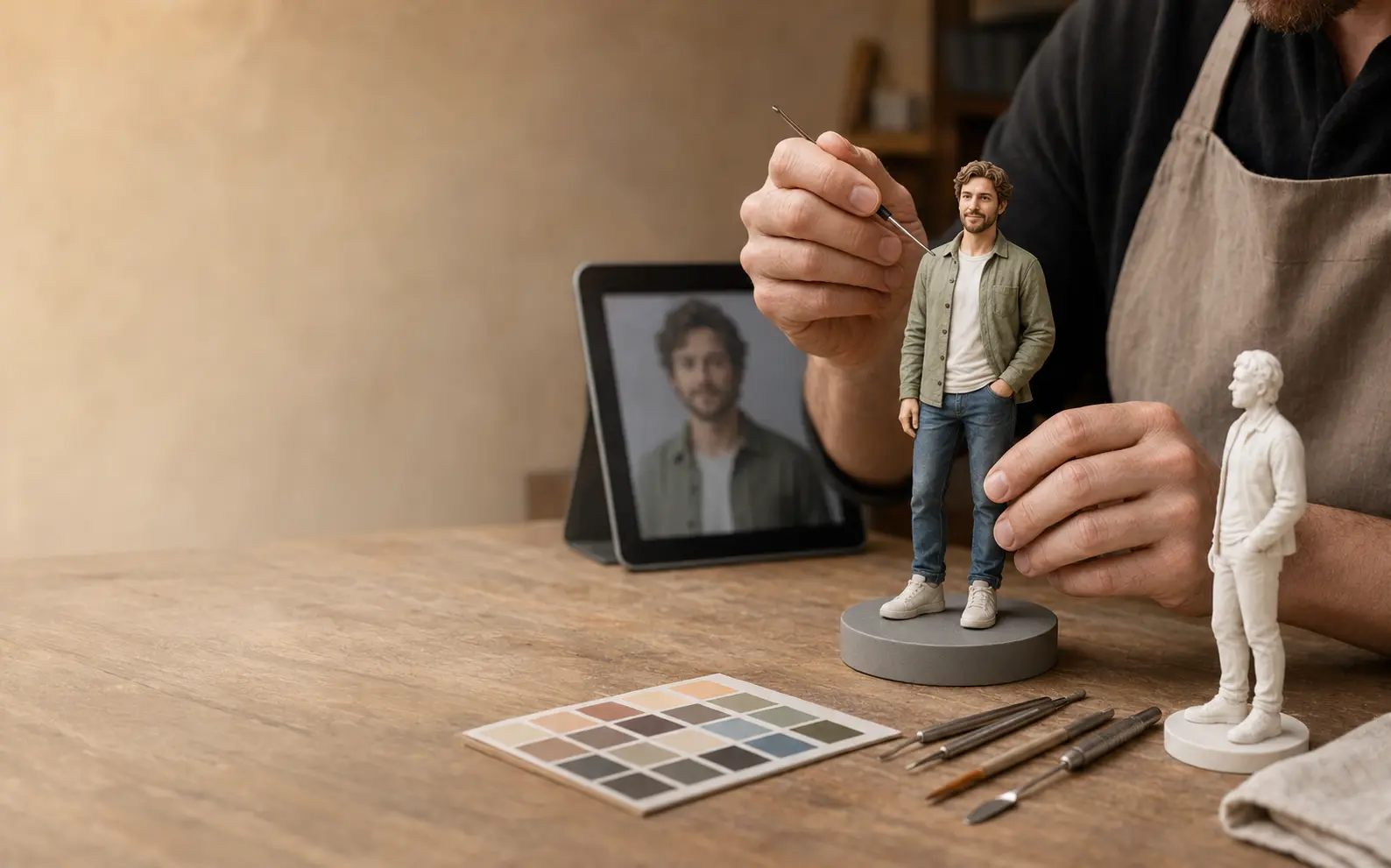
What changes is how the work is done. Instead of reading detail from the image, we work from what you tell us: which features mattered, what the person's posture was like, what they wore. Send the photo you have and describe what it does not show. That combination is usually enough, and it is far better than choosing a sharper photo of someone you did not mean to commemorate.
A meaningful result begins with a clear intention.
Choose the subject, moment and recognizable details you want the physical piece to carry. InkMee can help translate that direction into a full-color figurine designed for real-world display.