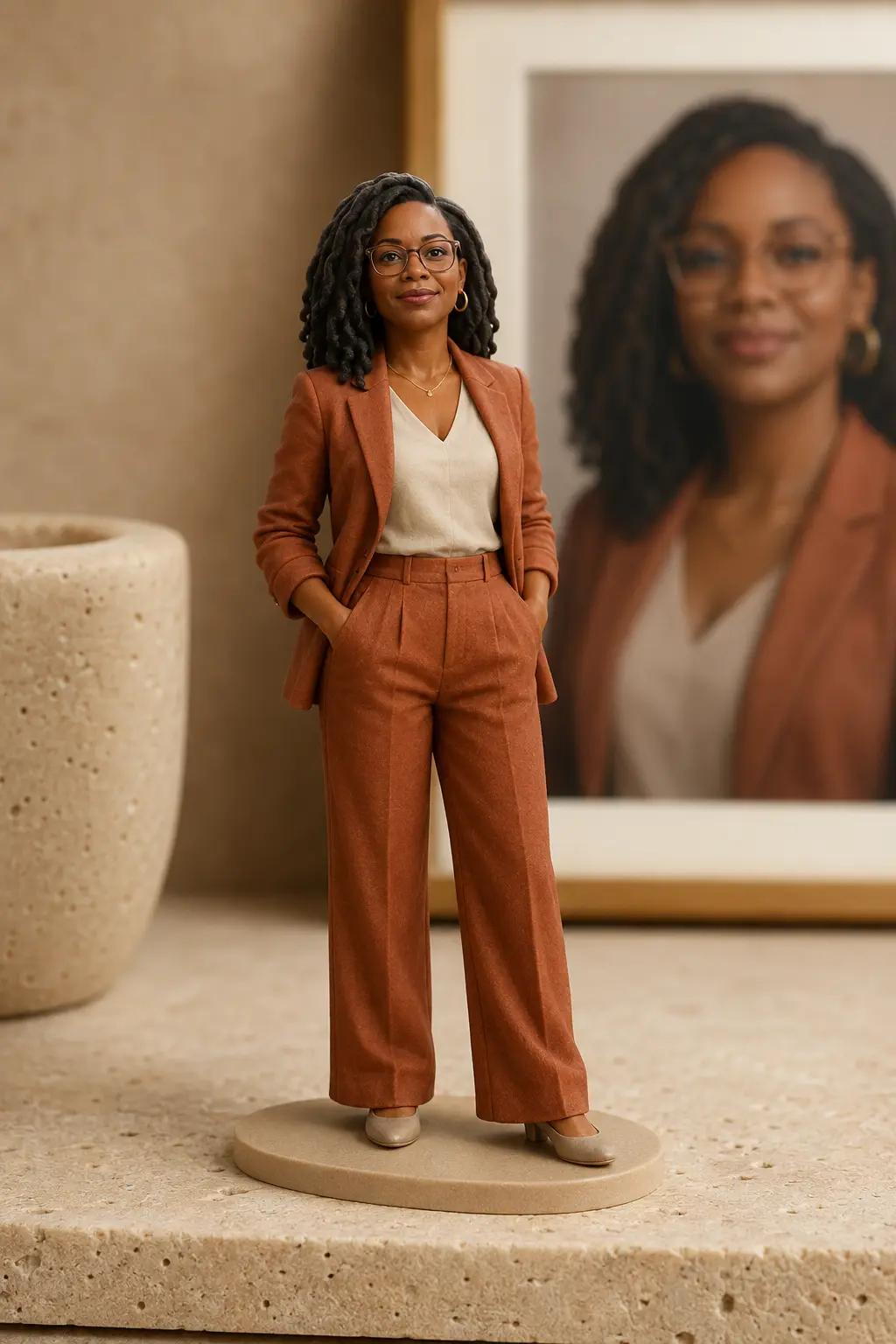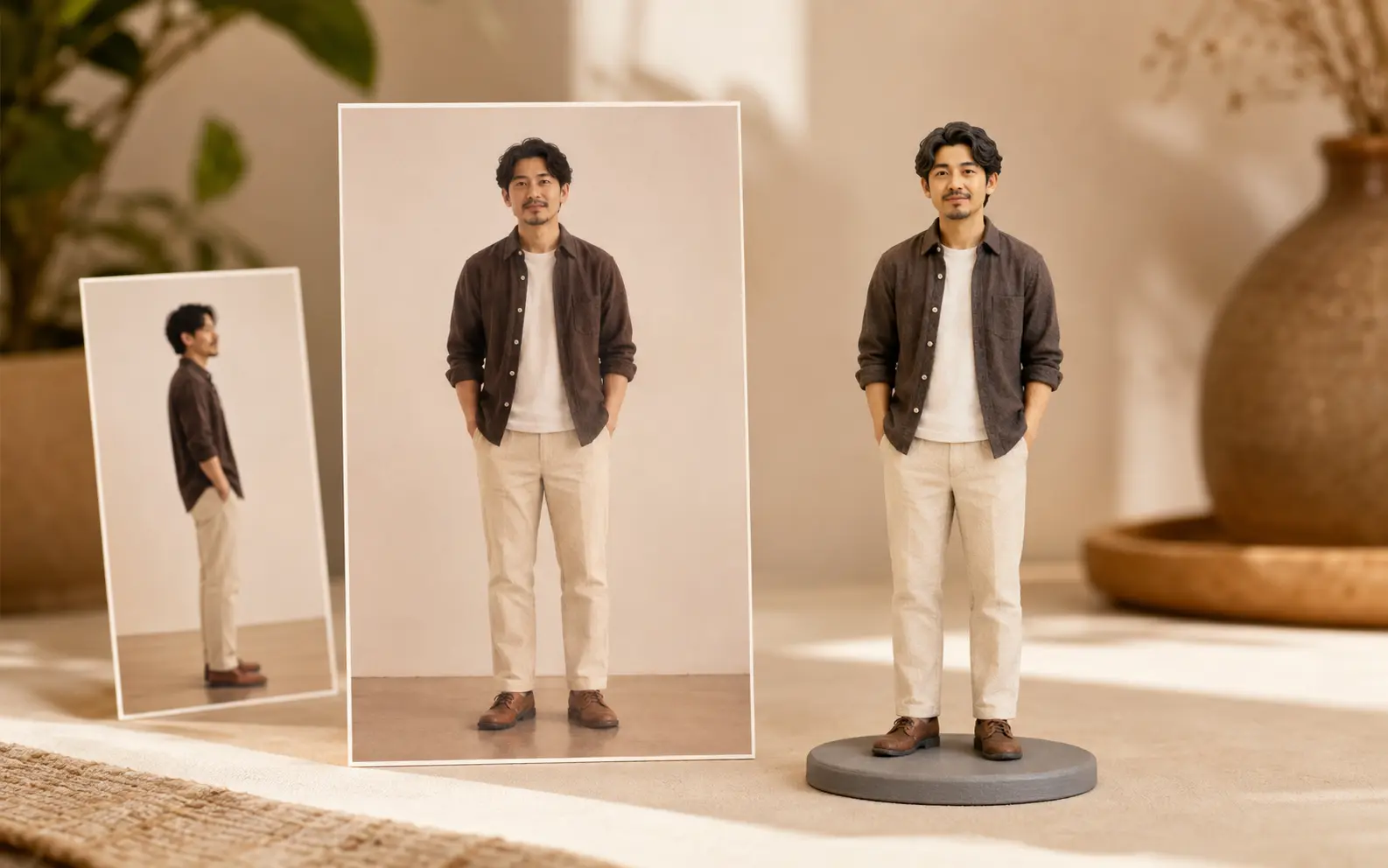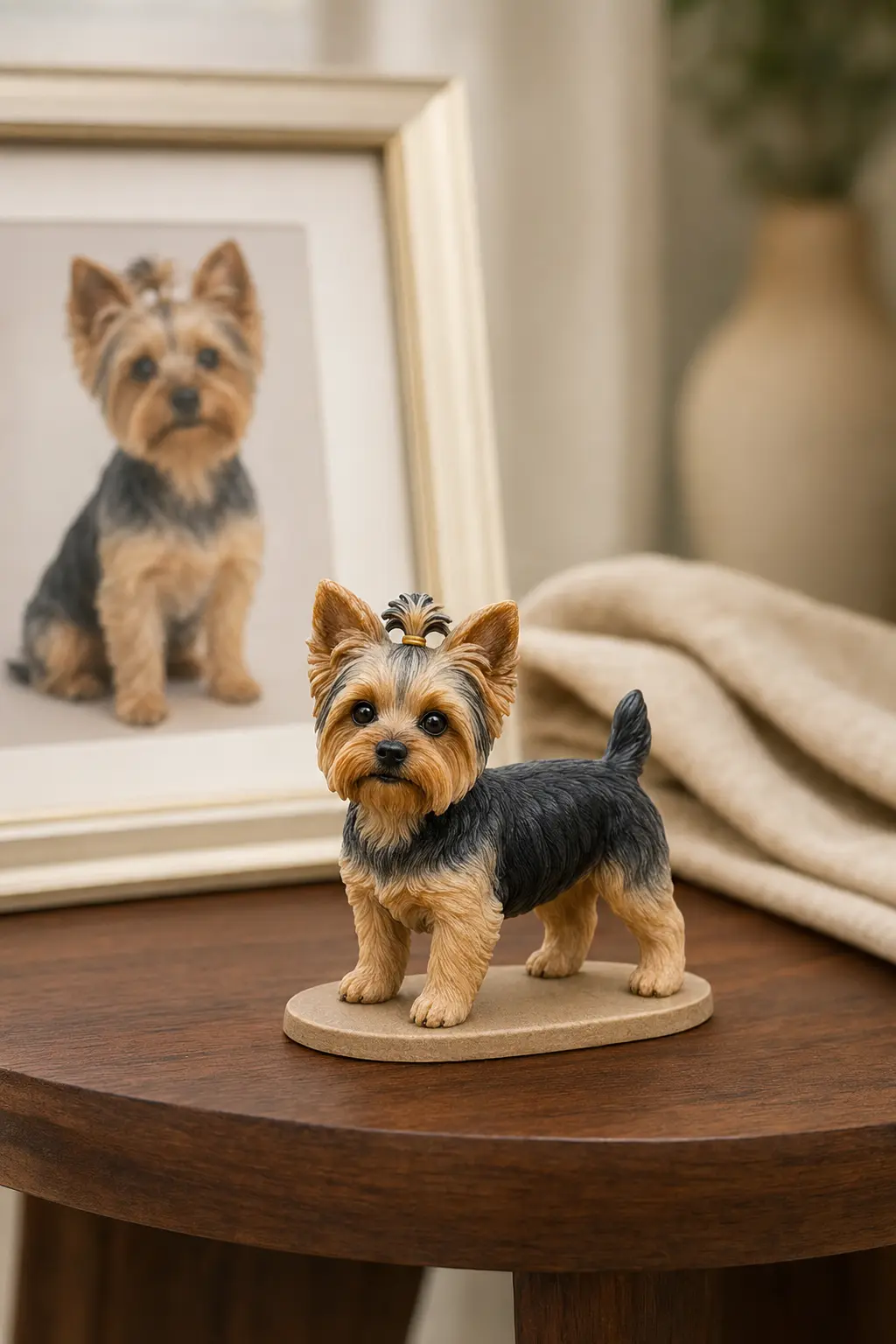
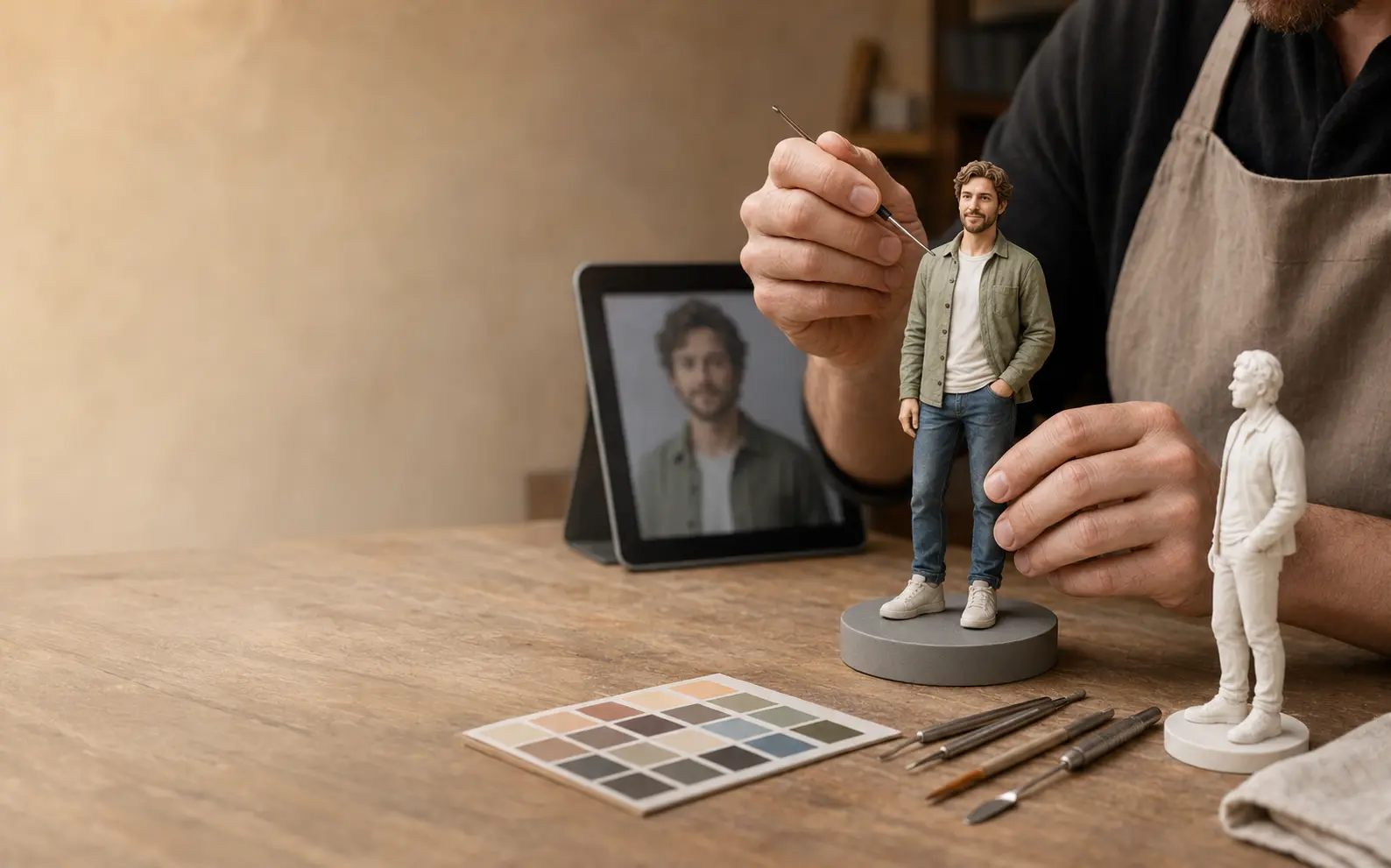
It is a reasonable assumption that a good photo plus a good printer produces a good figurine. It is also wrong, and the reason is worth understanding, because it explains almost everything about how long the process takes and why some requests are harder than others.
A photograph contains no depth
A photo is a flat projection: brightness and colour arranged on a grid. It records that a nose is lighter here and darker there, not that it protrudes. Human vision reconstructs the depth so convincingly that it takes effort to notice the information is not actually present.
A printer needs the opposite kind of data — a closed surface in three dimensions, where every point has a position in space. Nothing in the photograph states where the back of the head is, how far the shoulders extend behind the chest, or what the soles of the shoes look like. All of it has to be constructed.
What the model needs that the photo never had
Roughly half of a figurine is surface the reference never showed. The back of the hair, the reverse of the outfit, the underside of an arm, the space between the legs, the top of a shoulder seen from above: all of it is inferred from what the photo does show, plus knowledge of how bodies and clothes actually behave.
This is why one clear photo beats several conflicting ones. The reconstruction has to commit to a single interpretation, and two photos from different years or in different outfits do not narrow the answer, they widen it.
Why single-image 3D output is not printable
Tools that generate a mesh from one image have improved enormously, and their output looks convincing on screen. It is still not an object. Typical results are hollow shells with no wall thickness, geometry that self-intersects, parts that float unattached, and surfaces that simply stop where the camera stopped.
A screen forgives all of this, because a screen only ever shows you one side at a time and has no opinion about gravity. A printer does not forgive any of it. Turning that kind of output into something manufacturable is not a cleanup pass; it is most of the work.
- Closed, watertight geometry with real wall thickness
- No floating or self-intersecting parts
- Contact points wide enough to carry the weight above them
- Details thick enough to survive handling and shipping
The physics the design has to obey
A figurine has to stand up, and the base has to carry everything above it. That constrains poses in ways the photograph does not: a figure leaning far forward needs its weight redistributed, and a raised arm or lifted paw needs either thickening or support.
Overhangs are the other constraint. Any surface that projects outward past a certain angle has nothing beneath it during printing, so the design is adjusted so that unsupported spans stay within what the process can hold. This is invisible in the finished piece, which is the point.
Where the human decisions happen
The reconstruction pass is a sequence of judgements rather than a single operation. Which details are load-bearing for the likeness and must be protected. Which fine features have to be thickened, and by how much before they read as wrong. Where two elements should merge into one form because separately they would break.
Hair is the recurring example. Realistic strands are impossible at this scale and would snap even if they were not, so hair becomes shaped masses that read as the same hairstyle from a normal viewing distance. Deciding where one mass ends and the next begins is the difference between a figurine that looks like someone and one that looks like a mannequin.
Screen colour and resin colour are different things
A display emits light; a printed surface reflects it. The same nominal colour is a lit pixel in one case and a pigment lit by whatever is in the room in the other, so a perfect numerical match would still look different in your hand.
The palette is therefore translated rather than copied — adjusted so that the relationships between colours hold up under normal light, on a matte surface, at a small size. It is why a figurine photographs slightly differently from how it looked on the preview screen, and why that is a feature of the medium rather than a fault in the print.
A meaningful result begins with a clear intention.
Choose the subject, moment and recognizable details you want the physical piece to carry. InkMee can help translate that direction into a full-color figurine designed for real-world display.