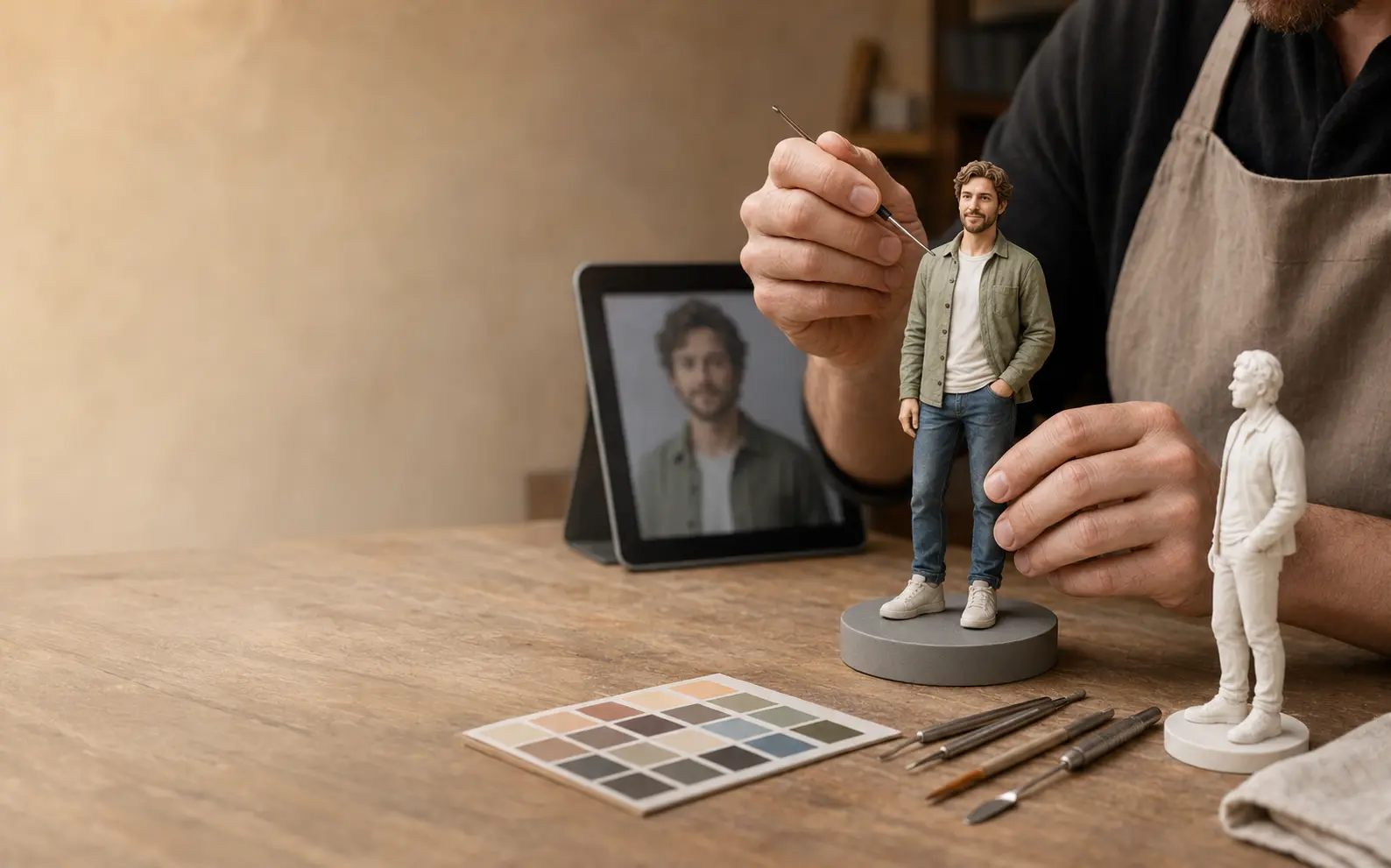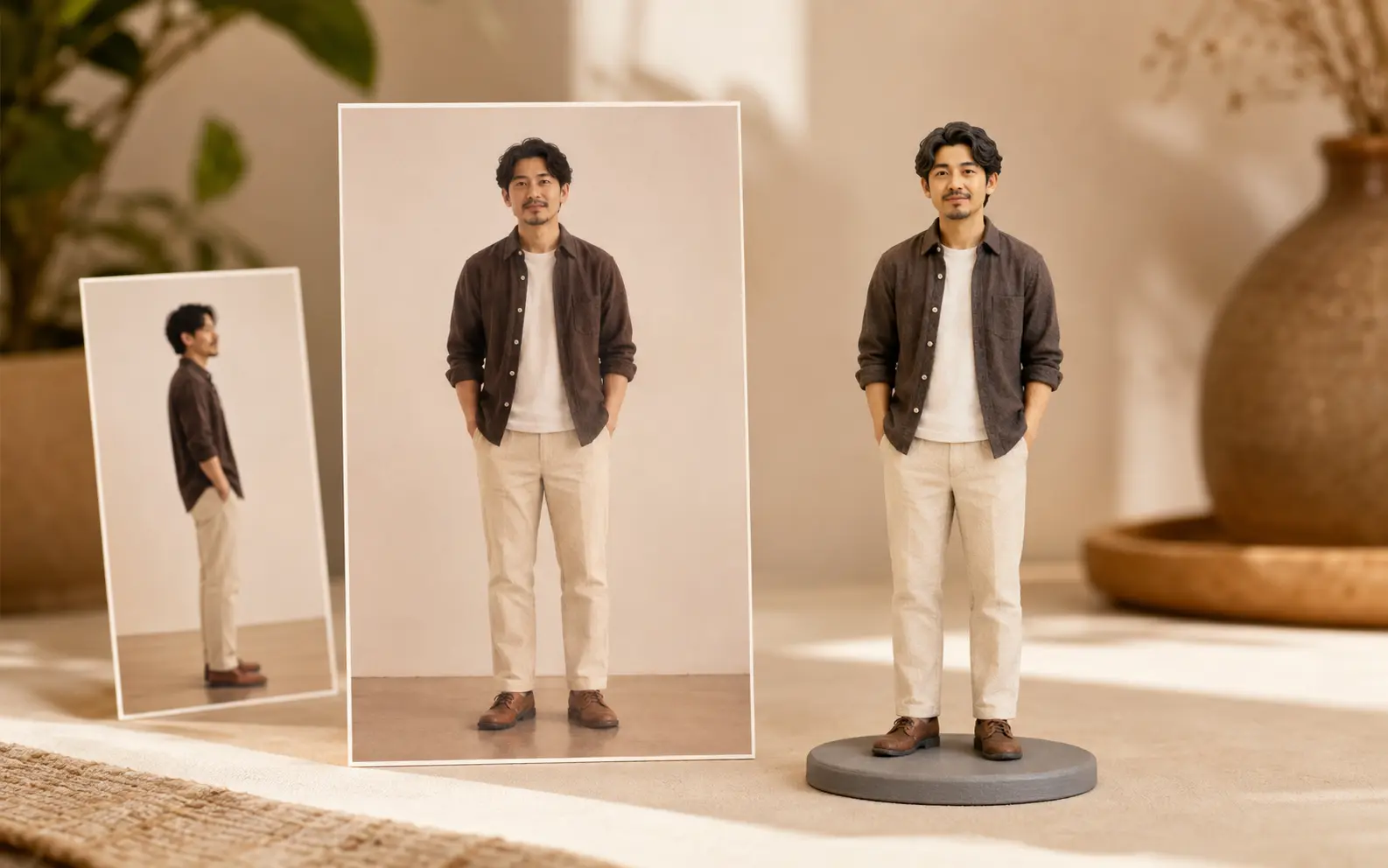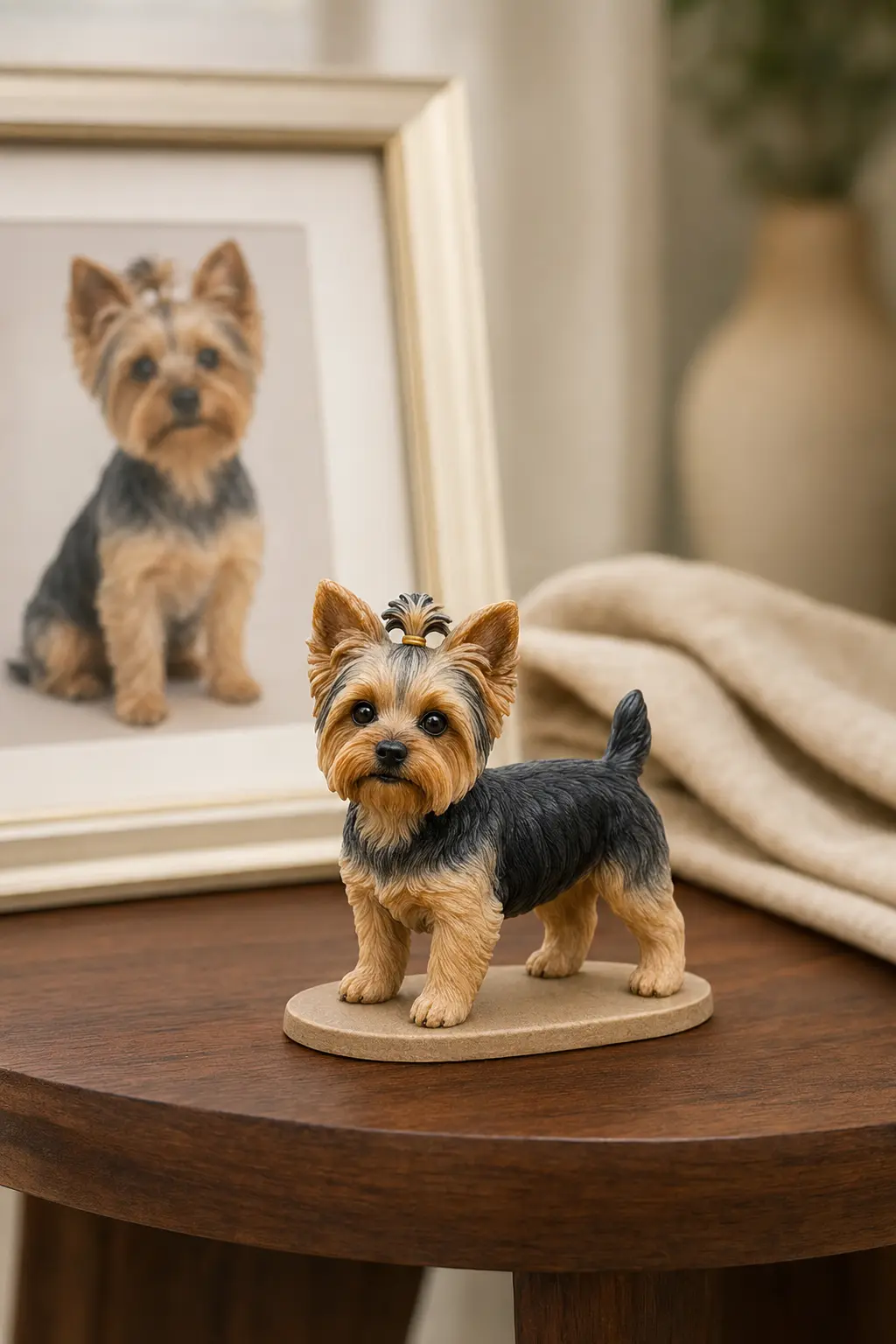
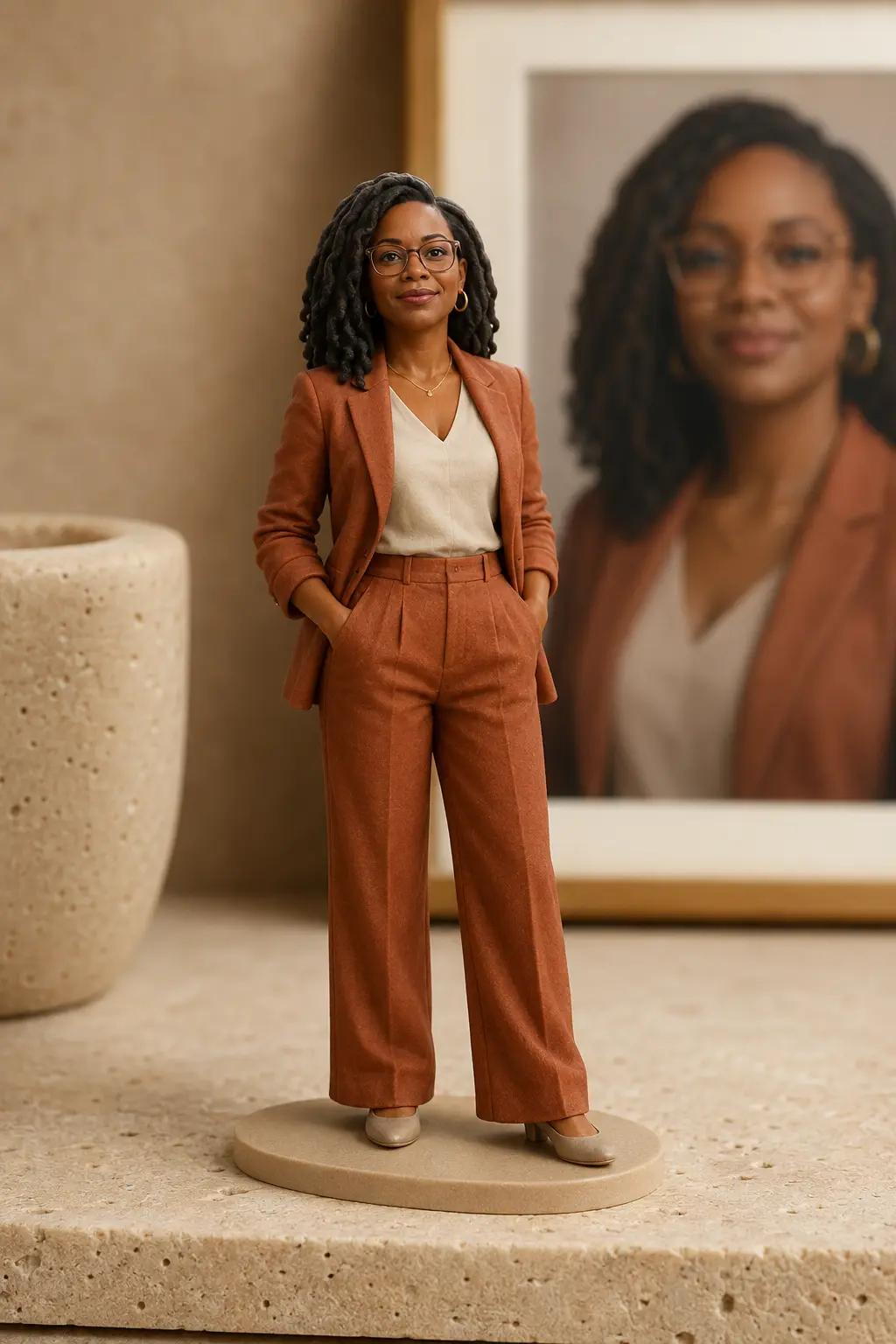
Ask someone how they recognise a friend and they will say “their face”. Watch how they actually do it and the face arrives late. You know who is walking towards you across a car park long before any facial detail is available, which tells you something useful about how a figurine eight centimetres tall can still be unmistakably a particular person.
The hierarchy of recognition
Recognition runs in a rough order: silhouette first, then hair shape, then posture and proportion, then clothing, and only then the face. The early items work at a distance and at small sizes. The face works only up close.
A figurine is almost always seen from across a room, which puts it firmly in the territory of the early items. So the design protects those first. Getting the silhouette and the hair right with an approximate face produces something people recognise instantly; getting the face right with a generic silhouette does not.
Why a face at this scale cannot be literal
At eight centimetres a whole head is roughly the width of a thumbnail, and an eye is smaller than the printer's finest reliable feature. There is no version of this process where a face is reproduced feature by feature — the geometry falls below what the machine can hold and what the eye can read.
What is reproduced instead is the arrangement: how far apart the eyes sit, where the brow line falls, the width of the jaw relative to the skull, how the hairline meets the forehead. Those proportions survive scaling down. Individual features do not, and chasing them produces a worse likeness rather than a better one.
The uncanny valley is a scale problem too
Pushing facial realism at small sizes tends to make pieces less appealing, not more. Half-resolved features read as something wrong with the face rather than as an approximation of a face, and the result is unsettling in the specific way that near-miss human likenesses are.
A slightly stylised treatment avoids this entirely. It signals clearly that the piece is an interpretation, which frees the viewer to read the cues that actually carry identity instead of auditing the face for errors.
What gets protected when the reference is weak
Not every commission arrives with a good photograph, and the process has to degrade gracefully. When information is missing, the order of protection is the same as the order of recognition.
Silhouette and hair are defended hardest, because losing them loses the person. Clothing is next, and can be reconstructed from a description when the image is unclear. Facial specifics are interpreted last and most freely, because at this size they carry the least. This is also why a sentence about what mattered is worth more than a second mediocre photo.
- Silhouette and overall proportion
- Hair shape and hairline
- Posture and stance
- Clothing and one or two signature objects
Deciding what to leave out
Every physical detail costs something — structural fragility, visual clutter, or both. A figurine that includes everything visible in the photograph reads as busy and breaks in transit; the craft is in choosing what to drop.
The rule is whether a detail is doing identity work. A distinctive pair of glasses stays, thickened enough to survive. A shirt's button placket is simplified, because nobody recognises anyone by it. A thin necklace chain becomes part of the neckline rather than a separate element, because as a separate element it exists only until the first knock.
A meaningful result begins with a clear intention.
Choose the subject, moment and recognizable details you want the physical piece to carry. InkMee can help translate that direction into a full-color figurine designed for real-world display.